 Aspens
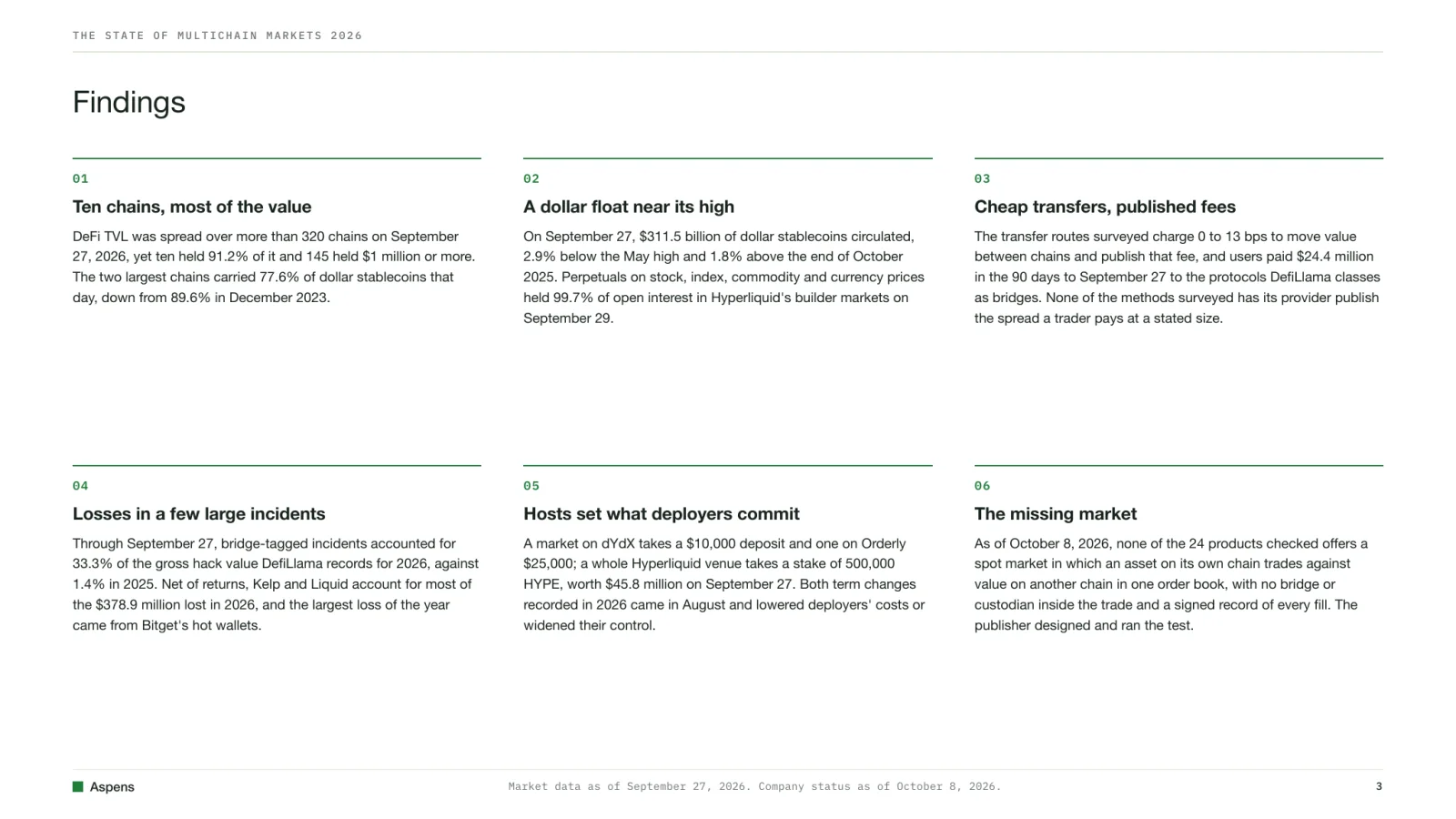
Six findings, each dated to its source.
- Ten chains, most of the value. DeFi TVL was spread over more than 320 chains on September 27, 2026, yet ten held 91.2% of it and 145 held $1 million or more. The two largest chains carried 77.6% of dollar stablecoins that day, down from 89.6% in December 2023.
- A dollar float near its high. On September 27, $311.5 billion of dollar stablecoins circulated, 2.9% below the May high and 1.8% above the end of October 2025. Perpetuals on stock, index, commodity and currency prices held 99.7% of open interest in Hyperliquid's builder markets on September 29.
- Cheap transfers, published fees. The transfer routes surveyed charge 0 to 13 bps to move value between chains and publish that fee, and users paid $24.4 million in the 90 days to September 27 to the protocols DefiLlama classes as bridges. None of the methods surveyed has its provider publish the spread a trader pays at a stated size.
- Losses in a few large incidents. Through September 27, bridge-tagged incidents accounted for 33.3% of the gross hack value DefiLlama records for 2026, against 1.4% in 2025. Net of returns, Kelp and Liquid account for most of the $378.9 million lost in 2026, and the largest loss of the year came from Bitget's hot wallets.
- Hosts set what deployers commit. A market on dYdX takes a $10,000 deposit and one on Orderly $25,000; a whole Hyperliquid venue takes a stake of 500,000 HYPE, worth $45.8 million on September 27. Both term changes recorded in 2026 came in August and lowered deployers' costs or widened their control.
- The missing market. As of October 8, 2026, none of the 24 products checked offers a spot market in which an asset on its own chain trades against value on another chain in one order book, with no bridge or custodian inside the trade and a signed record of every fill. The publisher designed and ran the test.
Value is concentrated on a few chains, with a long, thin tail.
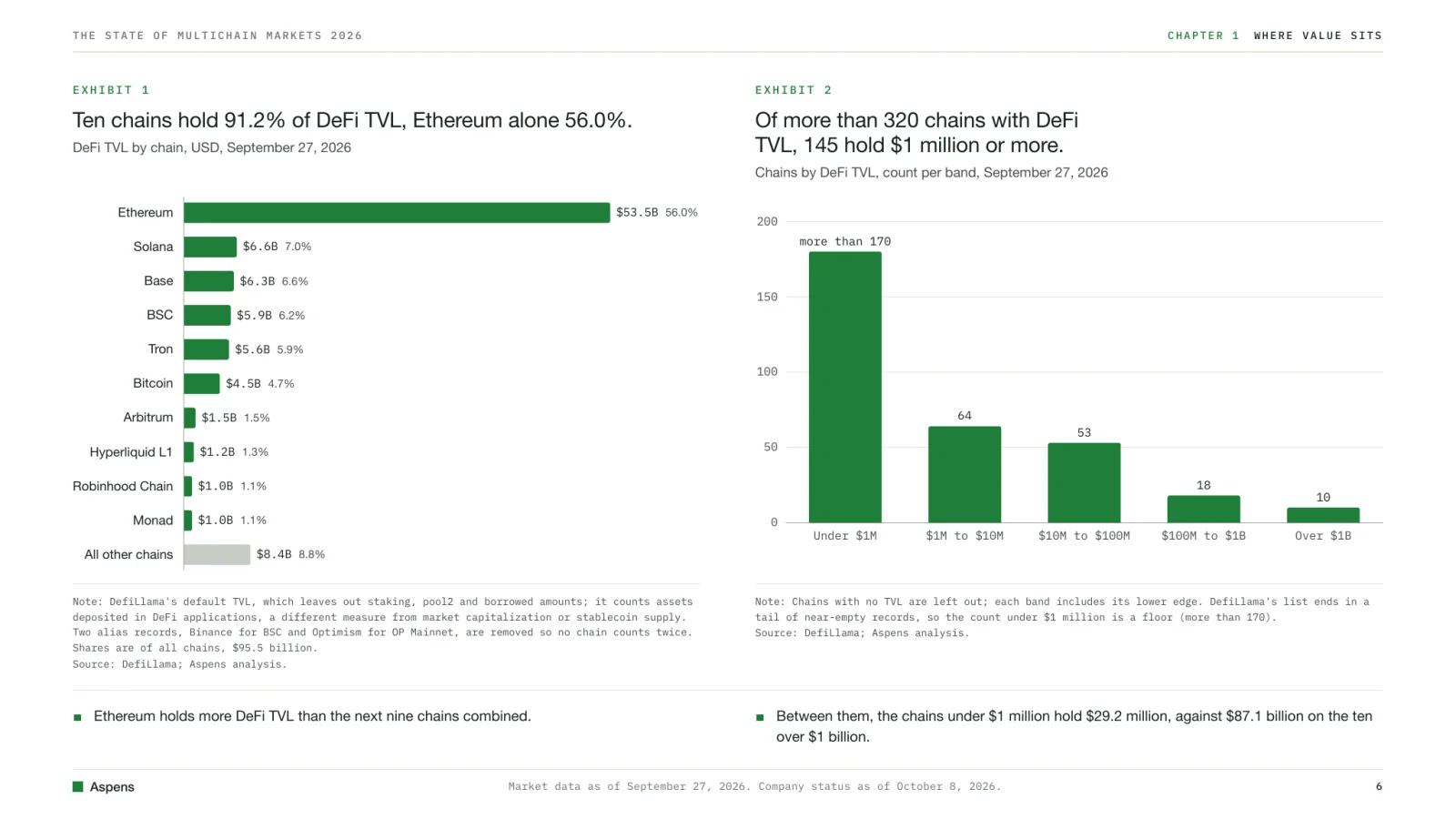
On September 27, 2026, more than 320 chains had DeFi TVL, and ten of them held 91.2% of it, Ethereum alone 56.0%. Between them, the chains under $1 million hold $29.2 million, against $87.1 billion on the ten over $1 billion. In stablecoins the concentration is easing: the two largest chains' share of the dollar float peaked at 89.6% in December 2023 and has since fallen to 77.6%. USDC is native on 38 chains, but 62.0% of it sits on Ethereum. L2 value fell from $57.6 billion to $44.7 billion in a year, and among L2s the four largest have held between 75.1% and 82.8% of value since January 2024. Five chains carry most spot DEX volume, and Robinhood Chain, launched in July, took 18.1% of September's.
Ethereum holds more DeFi TVL than the next nine chains combined.
The dollar float holds near its high; traditional-asset exposure trades as perpetuals.
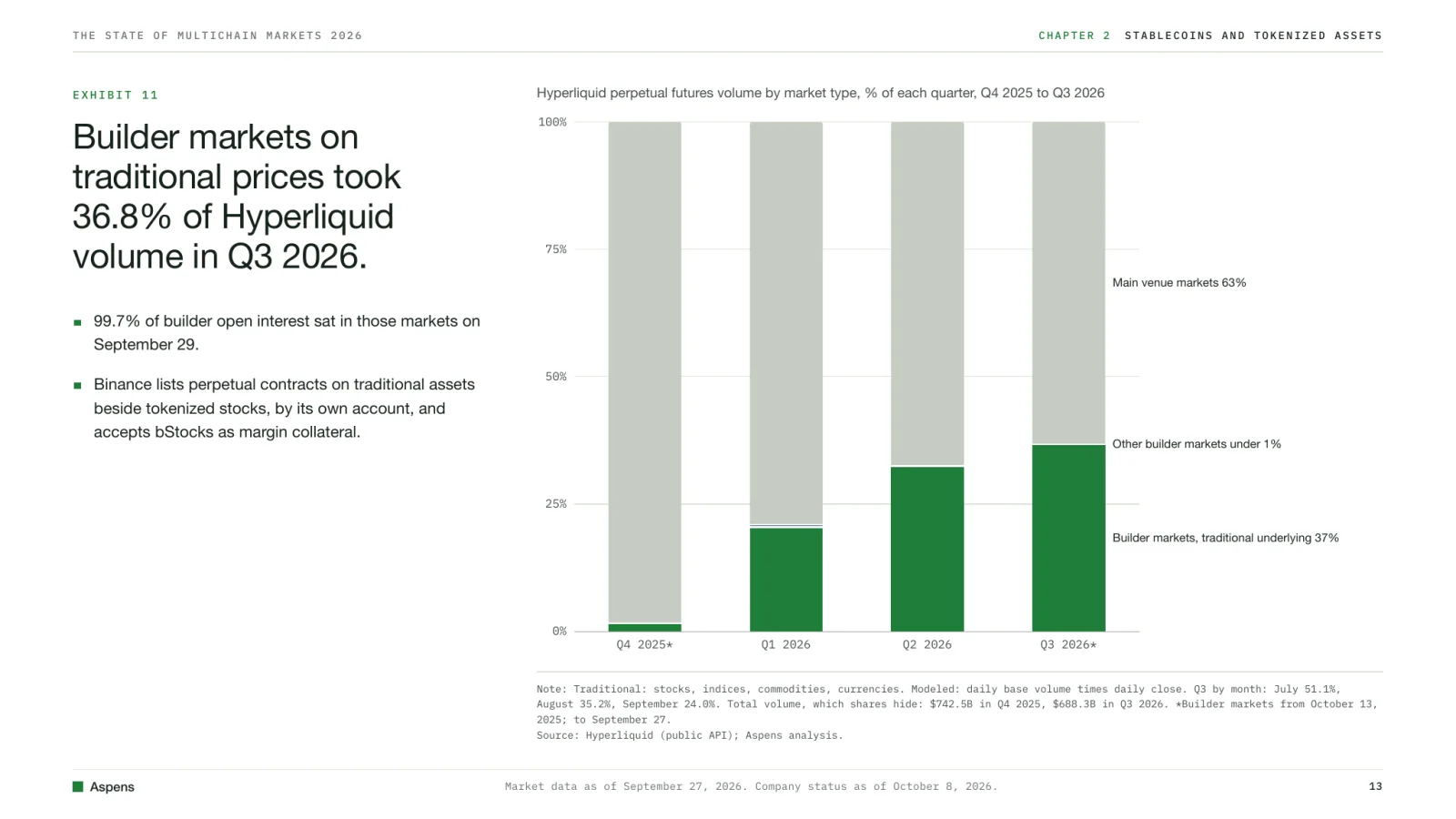
The dollar float stood at $311.5 billion on September 27, 2026, within 2.9% of its May high. From a year earlier it is up 5.6%, but from the end of October 2025 only 1.8%, so most of the past year's rise came before November. Non-dollar stablecoins rose from $319.3 million in January 2024 to $1.6 billion, still 0.5% of supply. Tokenized assets outside stablecoins total $43.4 billion on CoinGecko's count, or $20.2 billion without Figure's HELOC token, which is worth more than all tokenized treasuries and money market funds combined. Separately, three issuers hold 83.8% of the $2.4 billion in tokenized stocks. On Hyperliquid, builder markets trade stock, index, commodity and currency prices as perpetual futures, and 99.7% of builder open interest sat in those markets on September 29.
Builder markets on traditional prices took 36.8% of Hyperliquid volume in Q3 2026.
Crossing chains is five jobs, and transport is the one sold cheaply and openly.
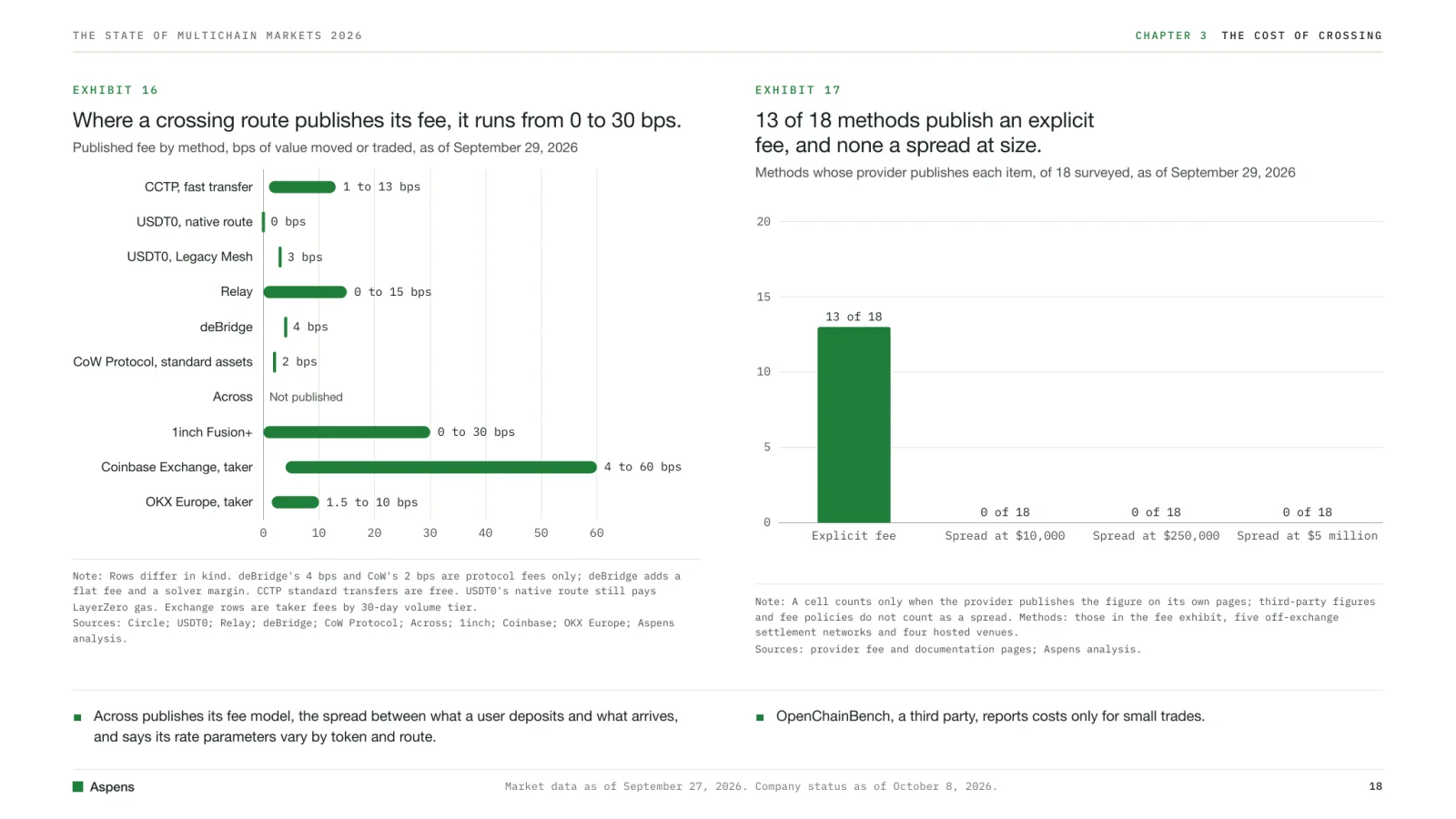
The five jobs are transport, exchange, settlement, rebalancing and netting. The transfer routes surveyed charge 0 to 13 bps to move value between chains, and each publishes that fee. On their own pages, the 18 methods surveyed state no spread a trader pays at a stated size. Users paid $24.4 million in the 90 days to September 27 to the protocols DefiLlama classes as bridges, and NEAR Intents took more than half of it. Five aggregators carried about 89% of bridge-aggregator volume in Q3 2026, LI.FI the most at 25.0%. Fees and spreads are one of four costs a firm pays to cross chains, beside custody and counterparty exposure, risk carried on the route, and proof rebuilt after the fact.
13 of 18 methods publish an explicit fee, and none a spread at size.
Losses where value crosses chains are concentrated in a few large incidents.
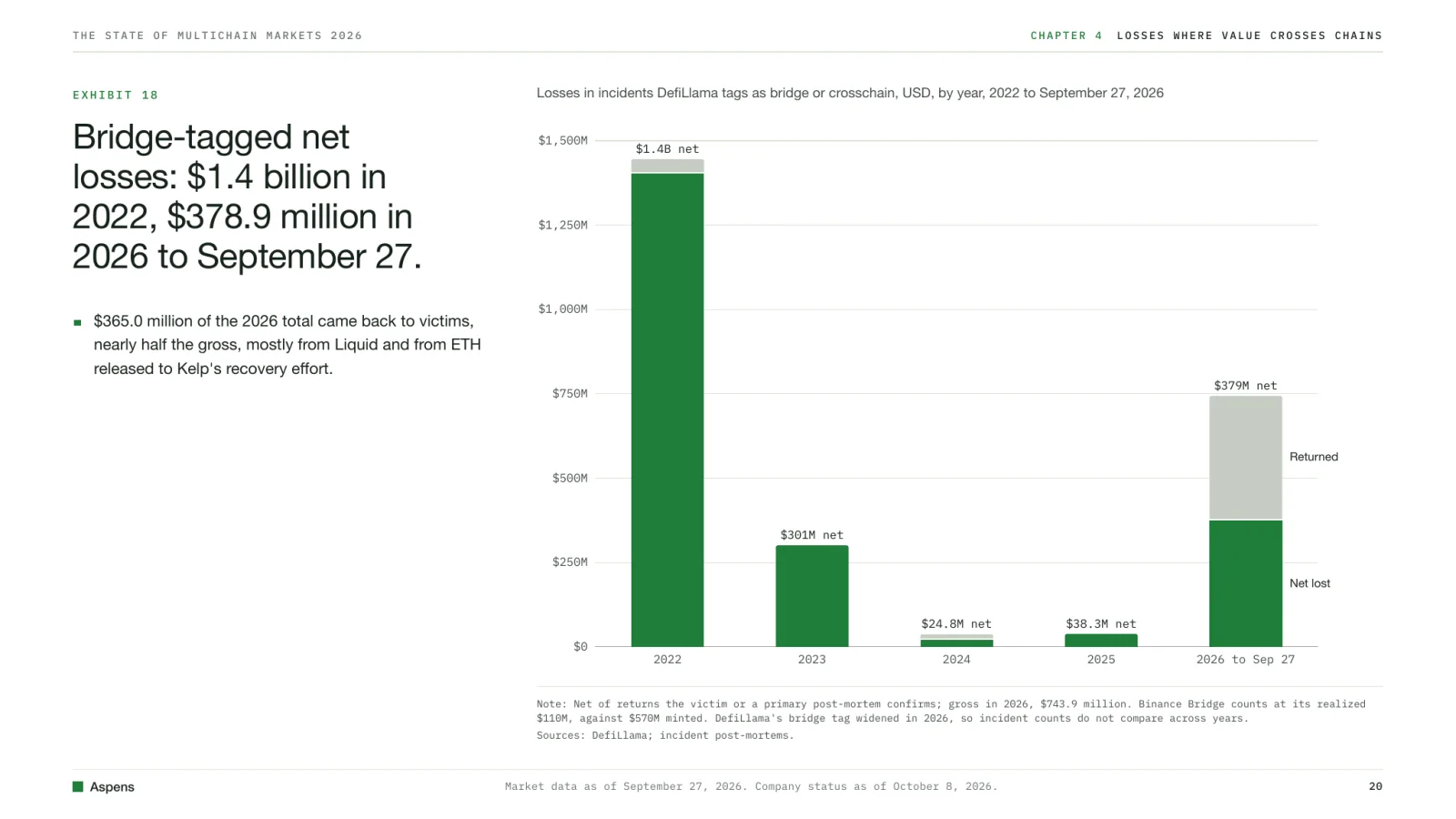
Through September 27, Kelp and Liquid account for most of the $378.9 million lost to bridge-tagged incidents in 2026 after confirmed returns, and $365.0 million of the 2026 total came back to victims, nearly half the gross. Because each year's total turns on a few incidents, the bridge-tagged share of the hack value DefiLlama records swings, from 52.4% of gross value in 2022 to 1.4% in 2025 and 33.3% in 2026. Classified from post-mortems, key compromise led losses in three of five years and code flaws in one. The largest loss of 2026 by net amount fell outside the bridge tag, at Bitget, a custodial exchange, after unauthorized transfers from some of its hot wallets on September 24.
Bridge-tagged net losses: $1.4 billion in 2022, $378.9 million in 2026 to September 27.
Hosts set the terms; their recorded 2026 changes eased them for deployers.
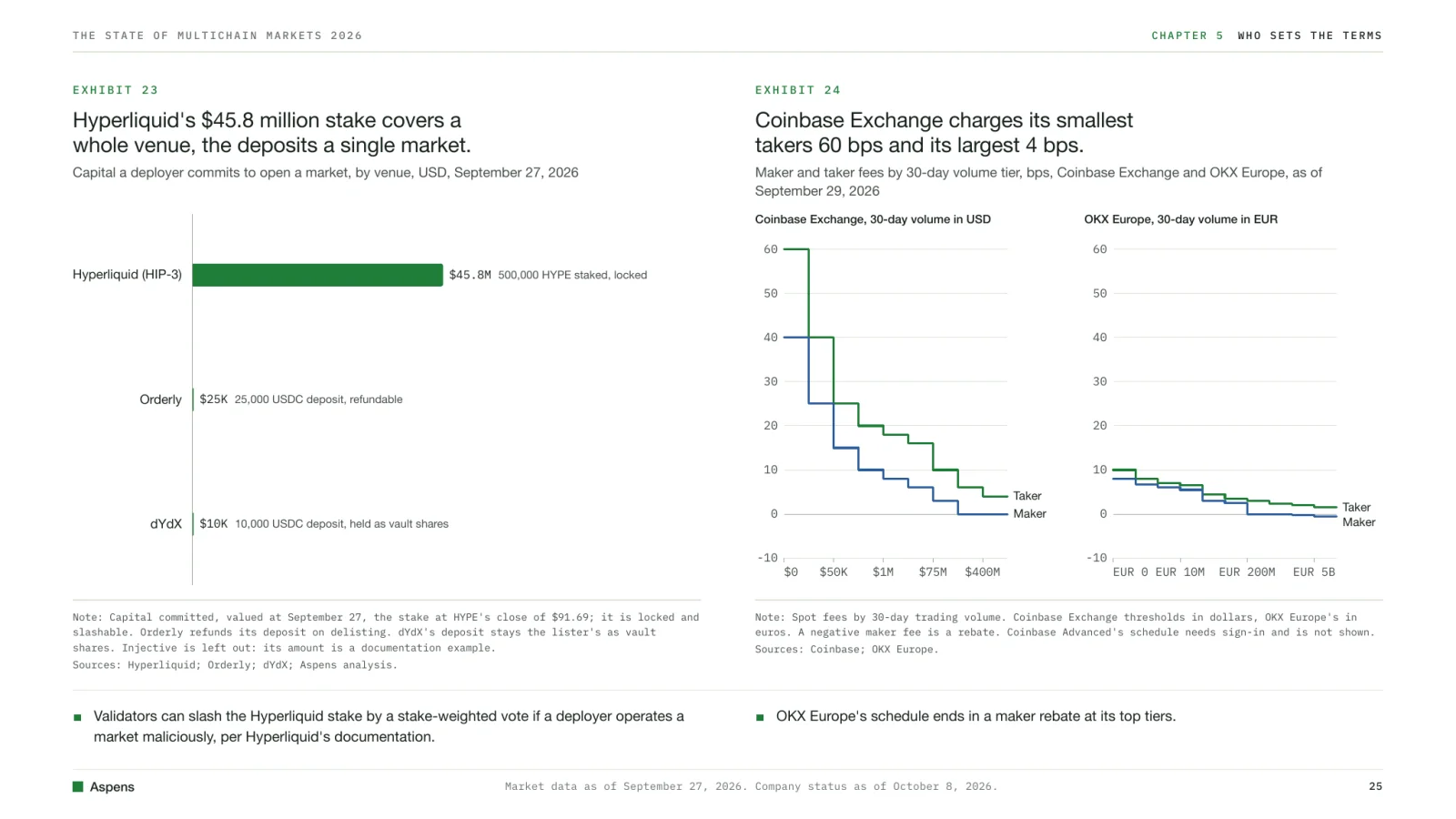
A market on dYdX takes a $10,000 deposit and one on Orderly $25,000; a whole Hyperliquid venue takes a stake of 500,000 HYPE, worth $45.8 million on September 27. Each host decides what a deployer keeps: Hyperliquid's deployers may keep up to half of their markets' trading fees, and Orderly pays market creators half its base taker fees. On August 12 Hyperliquid made its deployer fee scale configurable per asset, and on August 14 Orderly halved its per-market insurance deposit to $25,000, refundable on delisting. XYZ, the deployer behind trade.xyz, carried 99.0% of builder-market volume in Q3 2026. The five institutional off-exchange settlement networks surveyed make no claim to settle a trade's two legs on different chains.
Hyperliquid's $45.8 million stake covers a whole venue, the deposits a single market.
The same asset lives on many chains, and no product checked offers one order book across them.
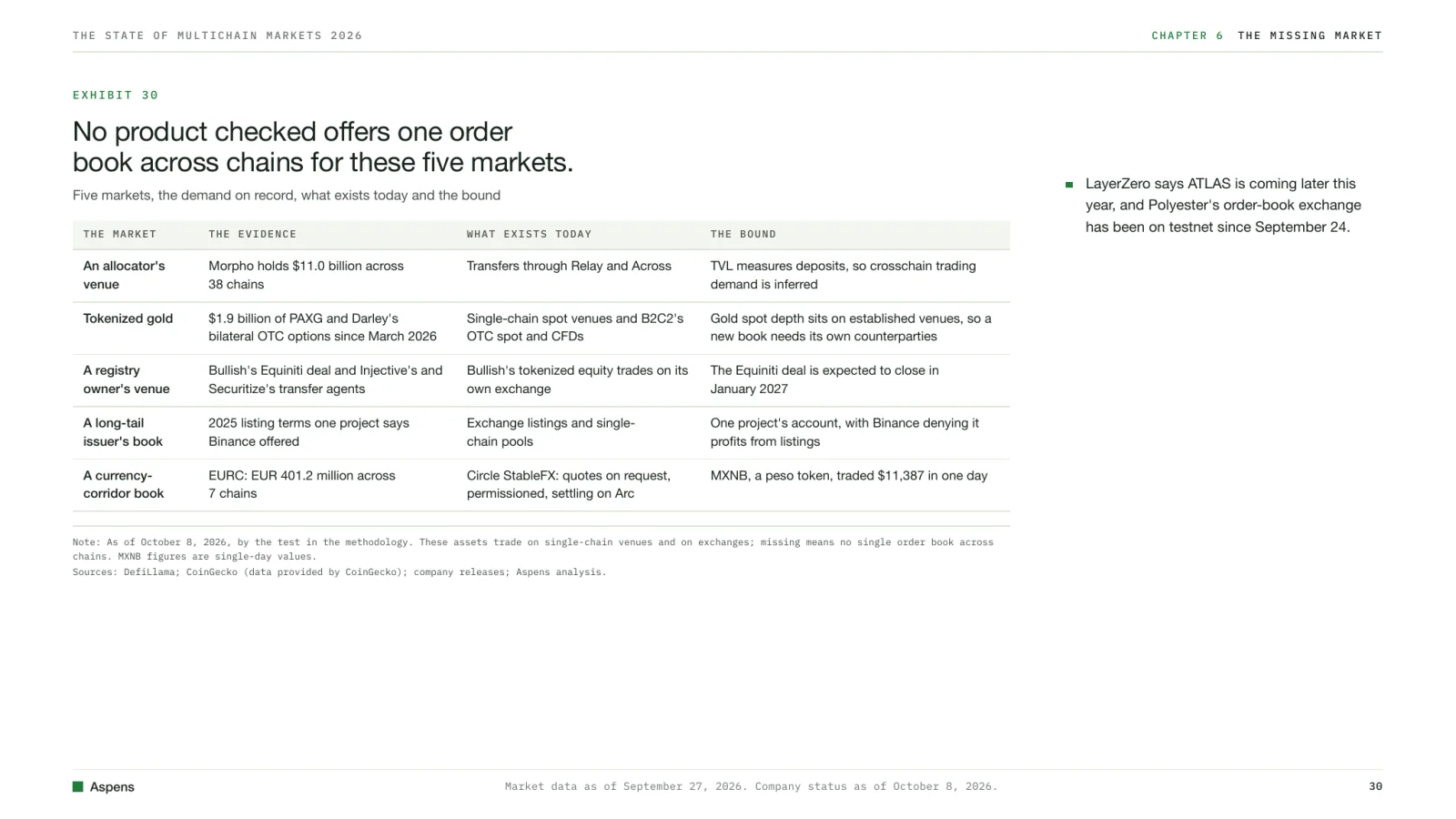
On September 27, 2026, thirteen of the fifteen largest dollar stablecoins lived on more than one chain, and USDC counted $1 million or more, native and bridged, on 69 chains. Custodial exchanges and hosted venues serve the exchange job, and bridges and intent networks serve transport. None of the six ways a firm can cross chains today serves exchange and settlement across chains in one order book with no custodian or bridge inside the trade. Five markets have demand on record and no such book: an allocator's venue, tokenized gold, a registry owner's venue, a long-tail issuer's book and a currency corridor, where EURC alone holds EUR 401.2 million across 7 chains.
As of October 8, 2026, none of the 24 products checked offers a spot market in which an asset on its own chain trades against value on another chain in one order book, with no bridge or custodian inside the trade and a signed record of every fill.
Aspens: direct crosschain markets, designed for any asset.
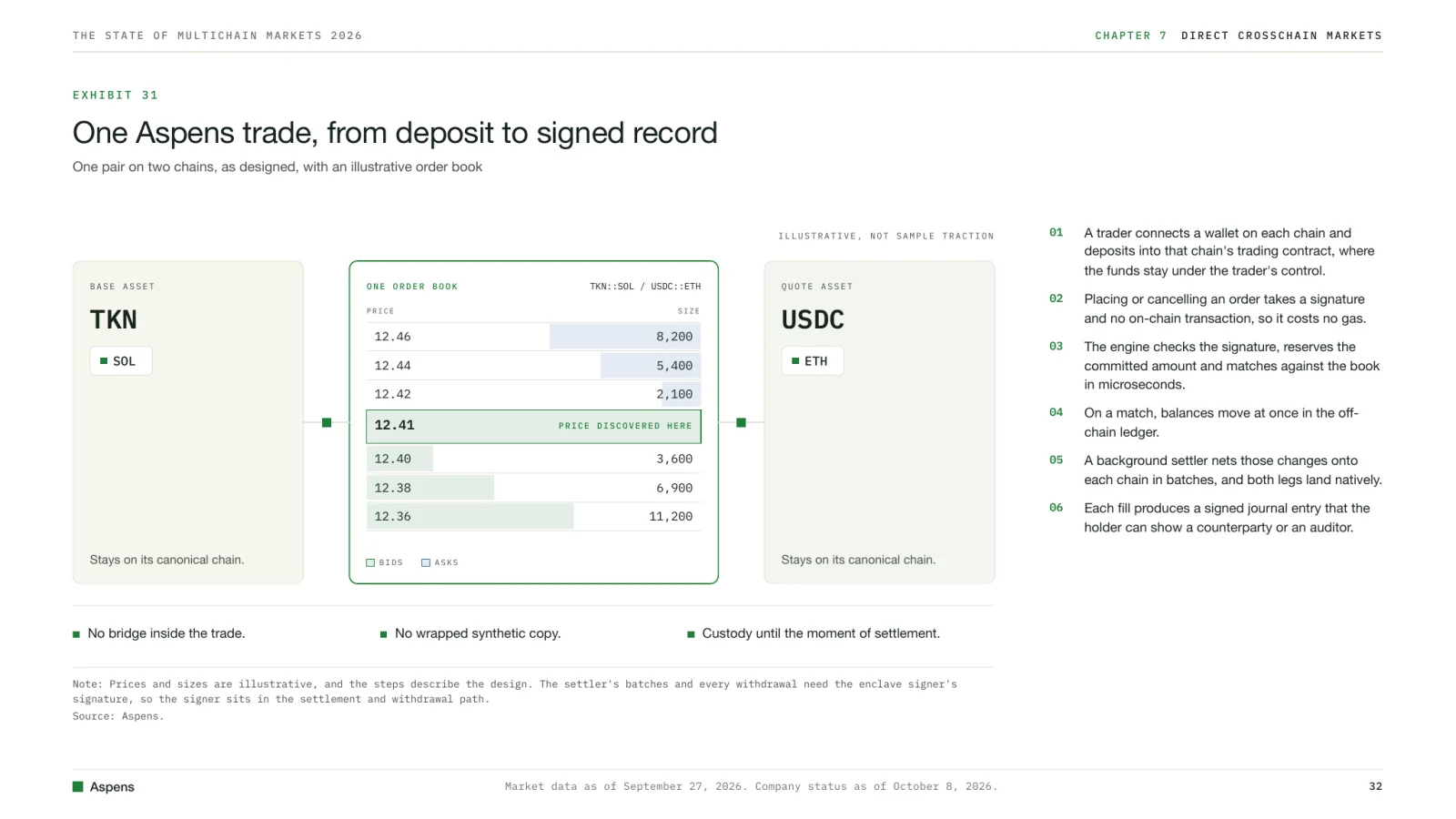
Aspens is built to give a firm a market for the route it needs: an asset on its home chain trading against stablecoins on other chains in one order book, custody kept by the trader until settlement, and a signed record of every fill in the holder's hands. Changing euros for dollars burns no euro and mints no dollar, and the design treats crossing chains the same way, as an exchange with no bridge or custodian inside the trade and the price discovered in the book. Settlement batches and withdrawals are signed inside an Intel TDX enclave, so the signer sits in the settlement and withdrawal path. A new Aspens market opens thin, without a venue's existing users, and four kinds of business gain little from one, starting with a firm whose whole business sits on one chain.
Each fill produces a signed journal entry that the holder can show a counterparty or an auditor.
Four questions before a new market.
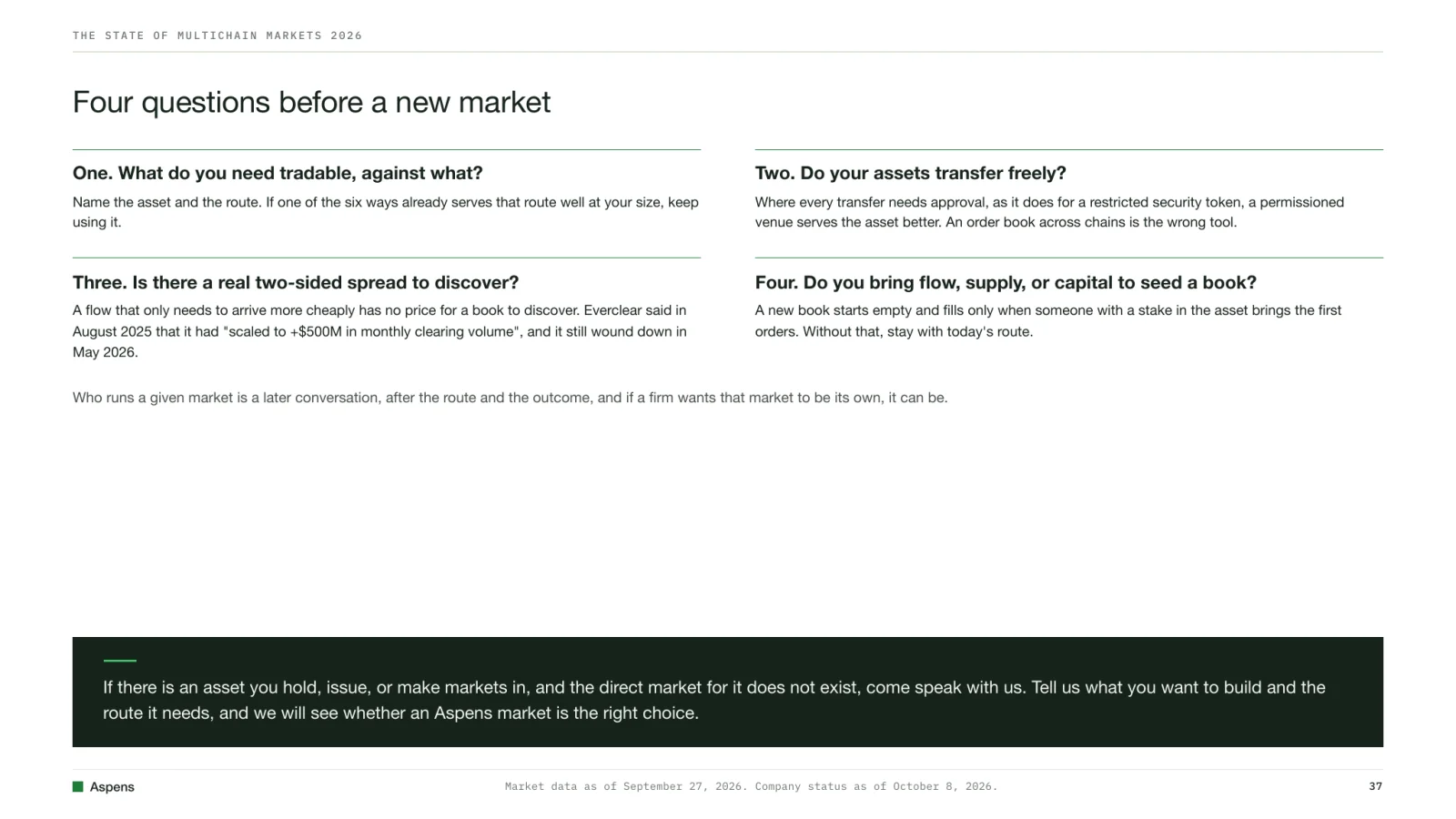
- What do you need tradable, against what? If one of the six ways already serves that route well at your size, keep using it.
- Do your assets transfer freely? Where every transfer needs approval, as it does for a restricted security token, a permissioned venue serves the asset better.
- Is there a real two-sided spread to discover? A flow that only needs to arrive more cheaply has no price for a book to discover.
- Do you bring flow, supply, or capital to seed a book? A new book starts empty and fills only when someone with a stake in the asset brings the first orders.
If there is an asset you hold, issue, or make markets in, and the direct market for it does not exist, come speak with us.
Who runs a given market is a later conversation, after the route and the outcome, and if a firm wants that market to be its own, it can be.
Market data to September 27, 2026; company status to October 8.
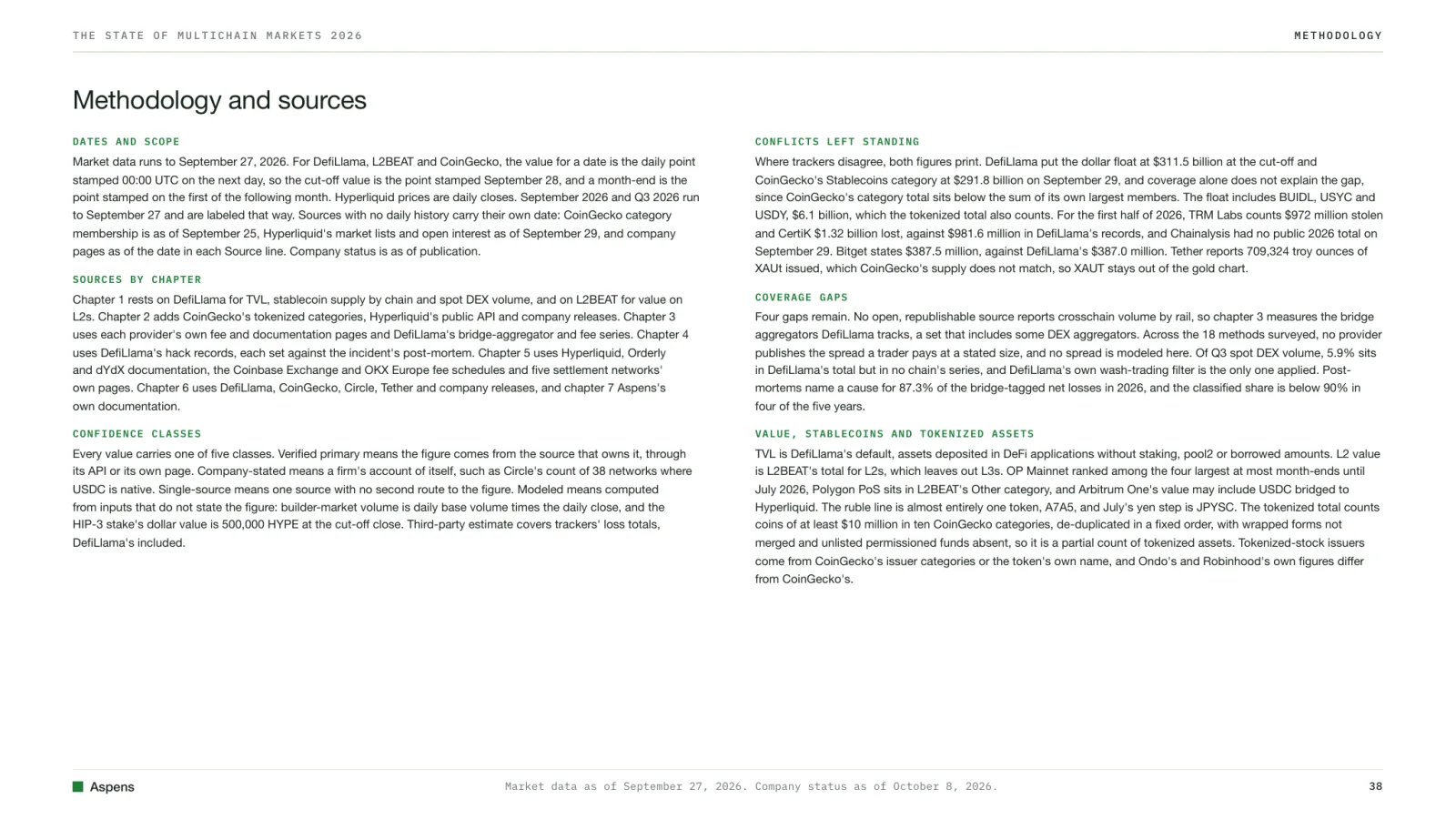
Market data runs to September 27, 2026, and company status is as of October 8, 2026. Sources are DefiLlama, L2BEAT, CoinGecko, Hyperliquid's public API, company documentation, filings and post-mortems, each dated in its exhibit's Source line. Every value carries one of five confidence classes: verified primary, company-stated, single-source, modeled, and third-party estimate. Where trackers disagree, both figures print: DefiLlama put the dollar float at $311.5 billion at the cut-off and CoinGecko's Stablecoins category at $291.8 billion on September 29.
Published by Aspens, a company building direct crosschain markets, which has a commercial interest in the market it describes. This report is for information only. It is not investment, legal or tax advice. CoinGecko figures: data provided by CoinGecko.
Questions this report answers
How concentrated is DeFi value across chains in 2026?
On September 27, 2026, more than 320 chains had DeFi TVL, and ten of them held 91.2% of it. Ethereum alone held 56.0%, and 145 chains held $1 million or more.
How many dollar stablecoins are in circulation?
$311.5 billion of dollar stablecoins circulated on September 27, 2026, on DefiLlama's count, 2.9% below the May high and 1.8% above the end of October 2025. CoinGecko's Stablecoins category was lower, at $291.8 billion on September 29.
What does it cost to move value between chains?
The transfer routes surveyed charge 0 to 13 bps to move value between chains and publish that fee. Of 18 methods surveyed, 13 publish an explicit fee and none publishes the spread a trader pays at a stated size. Users paid $24.4 million to the protocols DefiLlama classes as bridges in the 90 days to September 27, 2026.
How much was lost to bridge and crosschain hacks in 2026?
Through September 27, 2026, bridge-tagged incidents lost $378.9 million net of confirmed returns, against $743.9 million gross. That is 33.3% of the gross hack value DefiLlama records for 2026, against 1.4% in 2025. Kelp and Liquid account for most of the net loss.
What does it cost to open a market on a hosted venue?
A market on dYdX takes a $10,000 deposit and one on Orderly $25,000. A whole Hyperliquid venue takes a stake of 500,000 HYPE, worth $45.8 million on September 27, 2026.
Does any product offer one order book across chains?
As of October 8, 2026, none of the 24 products checked offers a spot market in which an asset on its own chain trades against value on another chain in one order book, with no bridge or custodian inside the trade and a signed record of every fill. Aspens, which builds direct crosschain markets, designed and ran the test.
Who published the report, and what data does it use?
Aspens published it. Market data runs to September 27, 2026 and company status to October 8, 2026, from DefiLlama, L2BEAT, CoinGecko, Hyperliquid, company documentation, filings and post-mortems. Aspens builds direct crosschain markets and has a commercial interest in the market it describes.